Building the Workforce of Tomorrow in Louisiana’s Energy Corridor
Factoring in Community Participation, Industry Needs and the Economy of Student Success
In Louisiana’s River Region—where global industry, logistics, and energy infrastructure shape day-to-day life—St. Charles Parish Public Schools is treating education as both a community mission and an economic strategy. District leadership describes a system built on clear expectations: high-quality learning for every student, modern support for well-being, and career pathways aligned with current regional economic demands.
That alignment is not theoretical. It is evident in curriculum decisions, partnerships with higher education and major employers, and in how students experience STEM learning during the school day rather than through optional after-school programming. At the same time, district leaders emphasize that a “whole child” approach—mental health supports, social-emotional learning, and safe campuses—is foundational to students’ academic and professional success.
As Superintendent Dr. Ken Oertling, St. Charles Parish Public Schools, frames it, the district’s purpose begins with a simple promise: “to provide high-quality educational opportunities for every student that really empowers them to become enthusiastic, lifelong learners and positive contributors to our local economy, parish, region, state, and country,” Dr. Oertling says.
Investing in Emotional Readiness
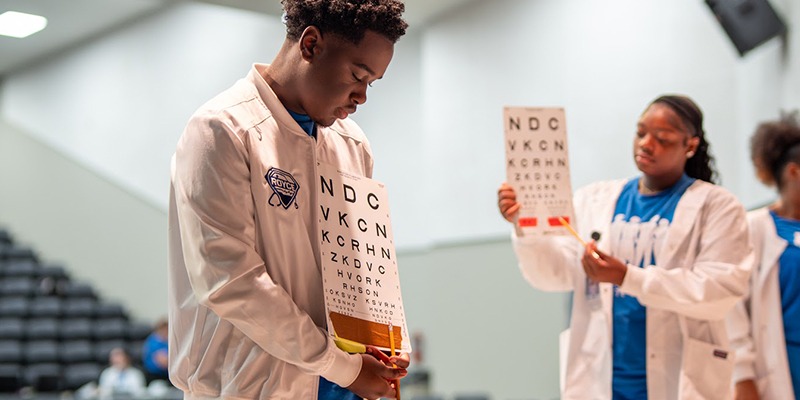
St. Charles Parish Public Schools has made a district-wide commitment to social emotional learning (SEL) and student wellness—an area Dr. Oertling describes as increasingly urgent as student needs evolve.
While the district has long supported SEL instruction in the early grades, leadership recognized the need for a more consistent, systemwide approach. “We have really doubled down on our focus and investment in social emotional well-being, social emotional learning,” Dr. Oertling explains.
A key step was adopting a unified SEL framework across all grade levels. “This past year, we actually adopted the 7 Mindsets Curriculum that’s common in nature and language from pre-kindergarten through 12th grade,” Dr. Oertling notes, creating shared language and expectations across schools.
The strategy extends beyond curriculum to include staffing, school culture, and early identification of students who may need support. “All of our schools are staffed with mental health professionals,” Dr. Oertling says. Schools also utilize wellness teams and dedicated spaces for both students and staff.
A central component is an annual student screening originally developed with LSU’s medical community. “Many times, there are silent sufferers,” Dr. Oertling says, noting that results help schools target supports and coordinate wraparound services with community partners.
Taking a Stand on Social Media’s Impact
District leadership recognizes that student well-being is shaped not only by what happens on campus, but also by the digital environment students navigate daily.
“We’re one of the first school systems to join the class action lawsuit against META and the use of those algorithms to really draw and really cause addiction of students,” Dr. Oertling says. The district has been identified as a bellwether system in the litigation, reflecting its willingness to confront external factors that impact student success.
The goal, Dr. Oertling emphasizes, is to address barriers to learning wherever they exist—inside and outside of classrooms.
A Regional Economy That Runs on Workforce
Few regions illustrate the link between education and economic development as clearly as the River Region. Ray Gregson, CEO of the River Region Chamber of Commerce, also serves as s St. Charles Parish School Board Member, giving him a unique perspective on workforce needs.
“For years, our area was a three-legged stool and now a four-legged stool,” Gregson says, referring to the region’s traditional advantages of river access, highways, and Class 1 rail. The fourth leg, he explains, is the workforce.
“If you want economic development, have a workforce,” Gregson adds, recalling conversations with executives evaluating investment opportunities in Louisiana.
Gregson points to the strong earning potential tied to the region’s industrial and energy sectors. “When you look at the average salaries for these jobs, you’re averaging $90,000 plus nowadays,” he says, noting that many of these roles are accessible to young adults early in their careers.
Turning Workforce Demand into Student Opportunity
Translating workforce demand into meaningful student opportunities is the responsibility of the district’s career and technical education system.
Ronnie Seal, Curriculum Specialist for School-to-Careers, says the district’s approach is guided by a simple principle: preparing students for fulfilling, sustainable futures. “It’s all about trying to make sure that we’re preparing our students to live productive, happy, and fulfilling lives,” Seal says.
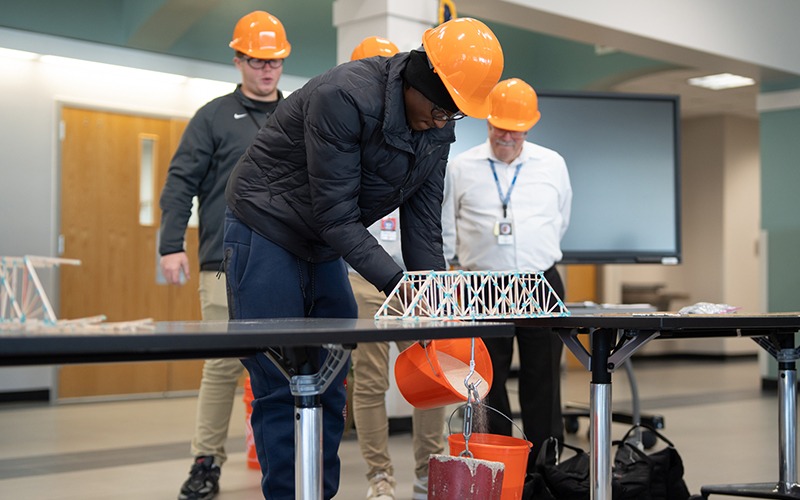
To do that, the district aligns courses, industry-based credentials, and dual enrollment opportunities with high-demand, high-wage career sectors. Regional partners have identified advanced manufacturing, trade and logistics, and energy, oil and gas as primary drivers, with additional emphasis on technology, environmental management, and biomedical sciences.
Seal explains that industry advisory boards play a hands-on role in shaping programs. “We’re learning from them and integrating their safety protocols, their cleaning protocols, and their tool management protocols into our skilled craft courses so that students are used to that culture,” he says, emphasizing the importance of workplace readiness alongside technical skill development.
Bringing Industry into the Science Classroom
Partnerships also extend directly into academic instruction, particularly in science.
Seal describes how the district shared essential science standards with industry partners and asked them to identify real-world applications tied to local careers. The result is industry professionals co-teaching lessons with educators.
“We had a process engineer, an environmental engineer, and a heater operator actually teach an eighth-grade science lesson,” Seal says, noting that every eighth-grade student at one middle school participated.
The impact has been measurable. “Those students performed higher on the district benchmark assessment, and we feel it had a strong correlation,” Dr. Oertling says, pointing to improved engagement and comprehension when students see how classroom learning connects to real careers.
Expanding STEM Access
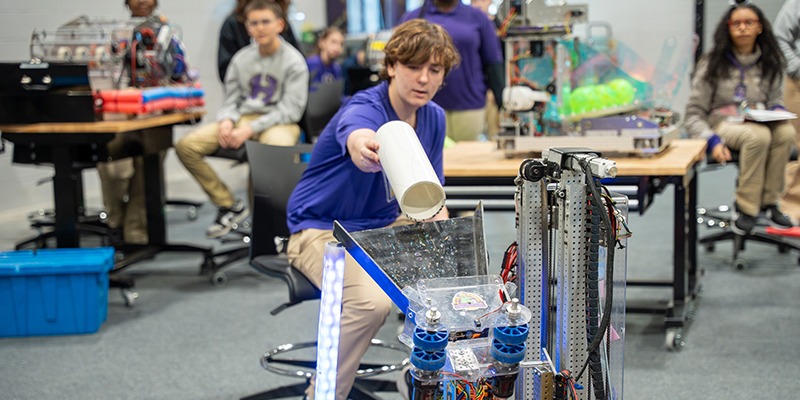
St. Charles Parish Public Schools has expanded STEM programming across grade levels with a focus on equity and access.
Even though most of the district’s schools had robotics teams that met after school, the district recognized that meeting after school limits the number of students who have access to these experiences. Therefore, STEM classes have been made available during the regular school schedule so that more students have access to quality STEM learning. Using Project Lead the Way (trademark) curriculum, programs begin as early as third grade with structured learning embedded into the school day. “We want to make sure that we’re making these opportunities available during the school day so that all students have access,” Seal says.
From a technology standpoint, the district is fully one-to-one. “We’re a Google district, and all of our students have Chromebooks,” Seal notes, adding that younger learners also use touchscreen devices.
Meeting AI with Policy, Training, and a Task Force
“This year we developed an AI task force looking at not just supports for our students, but for educators as well,” Dr. Oertling explains. The task force is charged with refining policies, evaluating platforms, and identifying responsible ways to integrate AI into instruction and operations.
Digital citizenship remains a core focus, with structured guidance for students on responsible technology use.
At the same time, Seal says the district’s career programs will need to stay agile. “We’re going to have to keep our finger on the pulse of what implications AI creates,” he says, “so that if we have to make adjustments, then we’re going to have to respond.”
A Career Center Model Built for Scale
St. Charles Parish Public Schools enrolls approximately 9,000 students, with 3000 of those students between two high schools and a career center
that offers project-based learning aligned with industry credentials and dual enrollment. Participation has grown significantly. “For a long time, we had 200 students, and now we have over 1,000 students attending that career center every year,” Dr. Oertling says.
One of the center’s most distinctive features is a functioning processing unit modelled after those used in industrial plants. “We’re actually building a processing unit that you would see in a plant with water, not chemicals,” Dr. Oertling explains, adding that students will operate it from a control-room environment.
Balancing Safety, Arts, and Academic Infrastructure
The district’s strategy is reinforced through targeted investment guided by long-range planning.
“We operate through a board-approved strategic action plan based upon annual needs assessments,” Dr. Oertling says, explaining that funding decisions align with identified priorities. Those include safety and security, arts education, career and technical upgrades, and student and staff well-being.
Safety investments range from school resource officers at every campus to advanced security systems, safety vestibules, protective window film, and regular coordinated training with law enforcement agencies.
The arts remain a signature focus as well. The district operates a performing arts center and ensures students from Kindergarten through Grade 12 participate in arts experiences that also engage the broader community.
What Comes Next: Literacy, Universal Pre-K, and Staying Ahead
Looking ahead, Dr. Oertling emphasizes that literacy remains a central priority. The district has been recognized statewide for early literacy performance, and leadership recently approved a major expansion.
“Our board just approved universal Pre-K to be offered for all in our community, starting next year,” Dr. Oertling explains, calling it a critical investment in long-term student success.
Dr. Oertling concludes by describing the district’s identity as one rooted in high expectations and adaptability. “We are a system of excellence with an unwavering commitment to being innovative and ensuring that our students are prepared for whatever career pathway that they choose.”
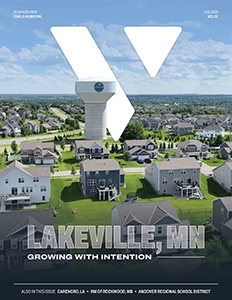
Click The Cover To View Or Download The Brochure
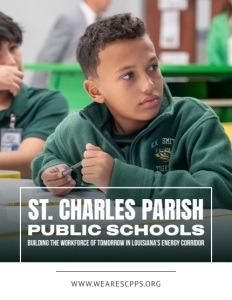
AT A GLANCE
Who: St. Charles Parish Public Schools
What: A public school district that prepares students for success by combining strong academics, student well-being, and career pathways aligned with the region’s workforce needs.
Where: St. Charles Parish, Louisiana, along the Mississippi River between New Orleans and Baton Rouge
Website: www.wearescpps.org
PREFERRED VENDORS/PARTNERS


ISO Services: www.isoservices.com
ISO Services is a full-service industrial maintenance and construction contractor with two local offices in Luling supporting St. Charles Parish. We offer comprehensive industrial solutions, specializing in scaffolding, insulation, coatings and tracing. Our skilled team is committed to delivering safe, efficient, high quality work on every job.
United Way of St. Charles: www.uwaysc.org
By partnering with donors, employers, community agencies and government, United Way of St. Charles brings a coordinated approach to solving community issues in the areas of EDUCATION, INCOME, HEALTH, and BASIC NEEDS. Based on information provided by our partner agencies, over 40,000 people are served in some way by United Way of St. Charles annually.