
The Freedom to Run the Business with the Right Supports in Place
Integrity-First Franchise Guidance, Strategic Collaboration, and an Evolving Model for Modern Ownership
In today’s franchising landscape, opportunity is abundant—but clarity isn’t always. That is the gap the National Franchising Association (NFA) aims to close. According to Michael Bullinger, President of NFA, the Association’s purpose is centered on one driving principle: bringing integrity back into the franchising business by helping people make well-informed, financially sound decisions that support long-term wealth creation rather than short-term mismatches.
When the Association was formed, Bullinger says, leadership believed the industry needed a change. In his view, that change is now underway. The NFA’s role is to ensure that franchising remains a credible vehicle for entrepreneurship, wealth-building, and legacy—by taking a deeper, more engaged approach with candidates and by strengthening the ecosystem of experts and resources around them.
Rather than speaking to a person once or twice and then pushing them toward a small set of brands, the Association works only with candidates who are willing to engage fully. That engagement begins with learning everything possible about the person and their situation—financial stage of life, investment capacity, goals, significant others involved in decision-making, desired lifestyle, and even exit strategies. From there, the Association focuses on education: how franchising works, what specific brands require, and how to evaluate the financial model properly before committing.
The objective is not simply franchise ownership. It is franchise ownership that makes sense for the individual.
Bullinger’s philosophy is direct: if the process is done properly, clients don’t end up a year later regretting the decision—and blaming the person who guided them there. The Association’s goal is to remove surprises from the relationship by making the decision rational, evidence-based, and aligned to the candidate’s real needs.
A Full-Spectrum Support Model That Continues After Purchase
A key differentiator for the National Franchising Association is that its support does not end at the moment of purchase. Bullinger describes the organization as one of the few groups that stays connected after a franchise is awarded, helping clients navigate the operational realities that often create financial pain for first-time owners.
This includes connecting franchisees with specialized resources, such as franchise-experienced accountants, attorneys, and real estate support teams. The Association’s position is that having “an attorney” is not enough; owners need attorneys who actually understand franchising, because many contract items are standardized and non-negotiable. Without specialized expertise, franchisees can overpay in legal fees while receiving advice that doesn’t improve the outcome.

Real estate is another high-stakes area. Bullinger shares his own experience as a former franchise owner, learning firsthand how expensive oversight can be if lease and maintenance responsibilities are unclear. The Association now works with specialists who help franchisees evaluate location strategy, negotiate commercial terms, and avoid costly surprises that can quickly erode profitability.
Beyond that, the NFA continues to build a broader resource network—experts who can support lead generation, CRM systems, and even AI-driven marketing tools. Bullinger notes that strong brands have become far more sophisticated in recent years, offering franchisees robust technology support, multi-channel marketing, and in some cases HR advisory services.
The brands that fail to evolve—or fail to provide that level of infrastructure—often struggle to scale. In Bullinger’s view, franchising is now a “new world,” and support systems must match the complexity of modern business operations.
Branding, Positioning, and the “Business Readiness” Gap
One of the recurring problems Bullinger sees is that many franchise brands may understand their business well, but don’t understand how to franchise it effectively. They may have operations manuals, training programs, and a proven model, but lack the infrastructure needed to position the business in the franchise marketplace.
To address this, the Association supports franchise brands through readiness assessments. One of Michael’s partners, Dr. Robert Needham, conducts what Bullinger calls a key assessment—an in-depth review that evaluates a business from multiple angles and produces a structured checklist of what is complete, what is missing, and what needs to be strengthened, including brand positioning and marketplace clarity.
Technology is part of that evaluation as well. The NFA works with technology-focused partners who can assess a brand’s systems and recommend improvements, whether that is CRM alignment, operational tech, customer-facing tools, or the internal systems required to support franchisees at scale.
The goal is straightforward: ensure brands are well-branded, properly positioned, and equipped with support infrastructure that makes them sustainable.
Bullinger also emphasizes that the Association’s strength is not only what it knows, but who it knows. NFA operates as a connector—bringing in subject-matter experts when specialized support is needed, building collaborative teams around clients rather than pretending to be an expert in every narrow niche.
The Most Common Pitfall: The Wrong Fit
While franchising can create powerful wealth outcomes, Bullinger is clear about the biggest danger: mismatch.
In his view, franchising sits in the middle of a spectrum. On one end are true entrepreneurs—people who want to invent, change systems, and do things their own way. On the other end are high-performing “workers”—people who thrive when direction is clear, structure is strong, and risk is limited. Franchising often works best for people between those extremes, but the exact position depends on the brand.
Some franchise systems are more entrepreneurial, allowing flexibility and experimentation. Others require strict compliance with a proven formula. The risk comes when someone on the extreme ends enters the wrong type of system. A true entrepreneur may fight the model and try to rewrite the rules. A true worker may struggle with the reality of ownership, risk, and leadership responsibility.
This is why the NFA emphasizes deep discovery and psychological fit—not just industry interest. Michael believes the decision should be based on preferences, motivations, lifestyle realities, and long-term energy. What will make someone excited to show up every day? What will create the work ethic required? What is the environment they can thrive in?
He also warns against the trap of paralysis by analysis. Due diligence is critical, but there comes a moment when a decision must be made. The Association’s role is to guide clients through the Franchise Disclosure Document, surface red flags, analyze failure rates and financial assumptions, and help the candidate decide with confidence—not fear.

If franchising isn’t right for someone, Bullinger considers that a win as well, because it demonstrates integrity and prevents costly mistakes. And in his view, integrity earns trust—which creates long-term referrals and goodwill.
The Direction of Franchising: Collaboration and “CEO Model” Ownership
Bullinger believes franchising is evolving toward a more collaborative investment model. Instead of a single person buying one unit to replace their income, he increasingly sees groups pooling resources, building multiple brands, and operating at a higher level—more like a CEO overseeing managers than an owner-operator working inside the business daily.
He rejects the idea that most opportunities are truly “passive,” but he sees strong growth in semi-absentee ownership models where systems are designed around leadership, delegation, and portfolio diversification. The strategy is to build one stable unit, reinvest in it, expand capacity, then add a second brand that serves the same general customer base with different services—creating both scale and diversification.
In his view, this approach is becoming more common as younger generations increasingly seek independence and entrepreneurship rather than long-term employment in traditional corporate structures.
Education and Resources: Webinars and an Operator Training Course
The National Franchising Association is now formalizing more structured educational offerings. Michael notes that the Association is preparing a webinar series intended to answer practical questions and help people better understand franchising and ownership decisions.
In addition, Dr. Needham is developing an operator-focused course designed to teach business fundamentals that franchise training often assumes but doesn’t always provide. Franchise systems train owners on their brand’s operations, but many new owners still lack a foundational understanding of how to run a business at a general level. The operator course is intended to address that gap—at an accessible price point—so that owners don’t fail simply due to missing core business skills.
Priorities for 2026 and Beyond
Looking into 2026 and early 2027, Bullinger outlines several priorities for the Association. One is expanding the resource ecosystem—bringing on more trusted vendors and service partners who can support franchise candidates and owners in every phase of the journey. Another is adding more “investment-grade” franchise brands to the Association’s platform through structured evaluation methods that assess financial viability and operational sustainability.
Education remains a major focus through webinars, training programs, and continued distribution of credible resources such as the FTC guide to buying a franchise and industry publications. And technology—particularly AI—will remain central. Bullinger is clear that the NFA has no intention of becoming the next Kodak or Blockbuster, watching industry change happen around it without adapting.
The Association’s strategy is to evolve with the industry while staying grounded in its core identity: integrity, collaboration, and long-term relationship building. For Bullinger, those values are not marketing language—they are the operating system that ensures franchising remains a credible path for wealth-building, and that clients are supported in a way that strengthens both their businesses and the industry as a whole.

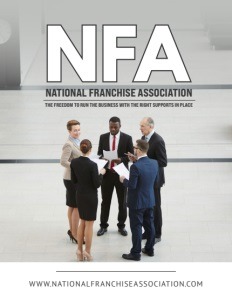
Click The Cover To View Or Download The Brochure
AT A GLANCE
Who: National Franchise Association (NFA)
What: The organization that educates, advocates, and provides valuable networking, materials, advice, and opportunities for its members to thrive in the franchising industry
Where: New Orleans, LA
Website: www.nationalfranchiseassociation.com