Courtesy of Experience Grand Rapids
A City ‘Rapidly’ Evolving
Riverfront Transformation, Housing Solutions and a Downtown Built for the Next Chapter
Grand Rapids has never been content to be a “best kept secret.” As City Manager Mark Washington describes it, the city is building momentum with intent—matching rapid growth with long-range planning, strong partnerships, and a focus on quality of life that continues to draw residents, employers and visitors.
Michigan’s second-largest city is one of the fastest-growing metropolitan areas in the state, and unlike many peer communities that experienced population decline in the 2010 and 2020 censuses, Grand Rapids continues to grow. That growth is fueled by a combination of economic strength, talent development and livability. Major employers and institutions anchor the region, and nearly 100,000 students graduate annually from area colleges and universities, feeding a strong local talent pipeline.
Add in relative affordability, nationally recognized safety metrics and a collaborative civic culture, Grand Rapids is positioned as a city “on the rise,” as Washington puts it—one where the public sector, private sector, nonprofit community and neighborhoods are aligned around transformational projects.
That alignment is now showing up measurably. The city is on track for its highest construction permit valuation on record, with nearly $1 billion in projects approved in a single year—approximately triple pre-pandemic levels. Planning Director Kristin Turkelson points to a key reason: predictability.
Grand Rapids has invested heavily in master planning and zoning reform over the decades, creating clear development expectations and streamlining processes for projects aligned with the city’s vision. Nearly all construction projects are reviewed administratively by staff, reducing time and cost for developers and making Grand Rapids a reliable place to invest.
Downtown Growth and the Power of Placemaking
The city’s downtown strategy is built around one central idea: people need reasons to be here—before work, during work and after work. Like many cities, Grand Rapids felt the impact of post-pandemic remote work patterns, which affected retail and office occupancy. The response has been to double down on placemaking and activation.
Festivals, public art, murals and year-round programming are not treated as extras—they are an economic development tool. Washington notes that Grand Rapids is home to one of the country’s most significant public art events, ArtPrize, drawing over a million visitors during a two-week festival period and generating significant economic impact for local businesses.
Courtesy of Experience Grand Rapids
To sustain downtown energy, the city is also pursuing residential density. A long-standing target has been building toward 10,000 downtown residents, and current projects are accelerating that trajectory. Housing demand is still high, and city leadership recognizes that downtown alone can’t solve the region’s housing shortage—but downtown density remains a major lever for economic vitality.
A Riverfront Reinvention Anchored by Destination Projects
If there is one transformation reshaping Grand Rapids, it is the Grand River corridor.
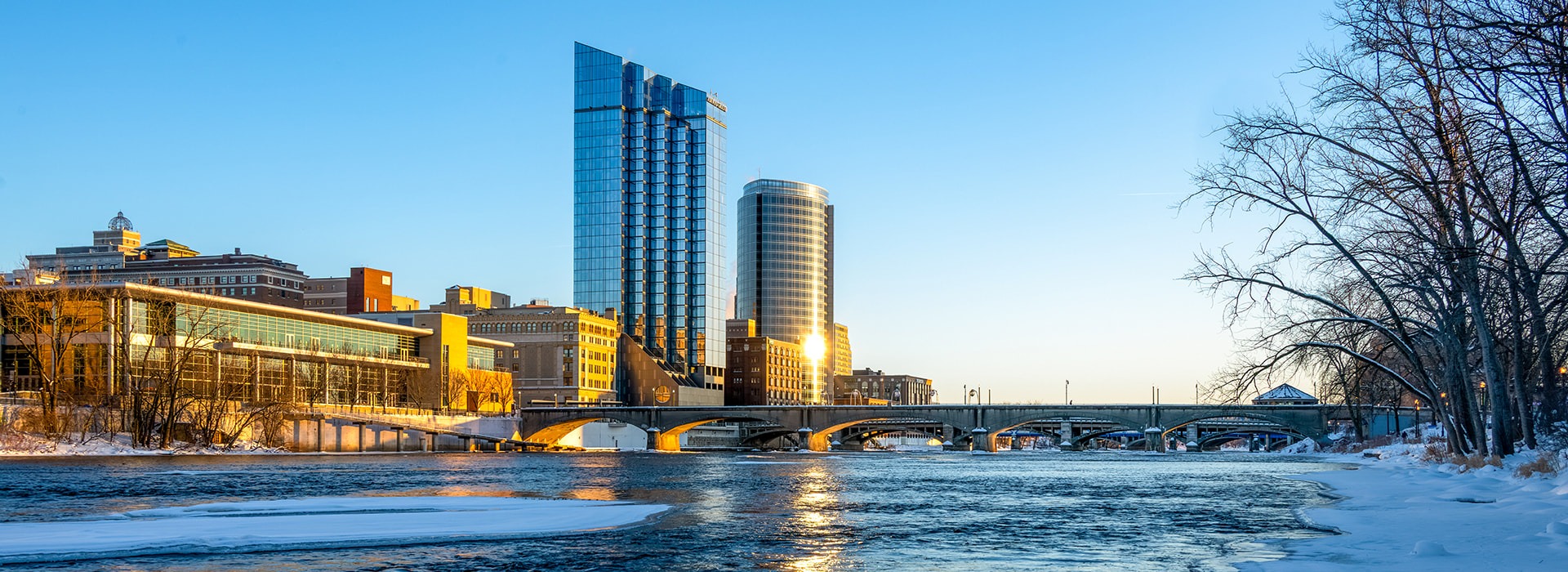
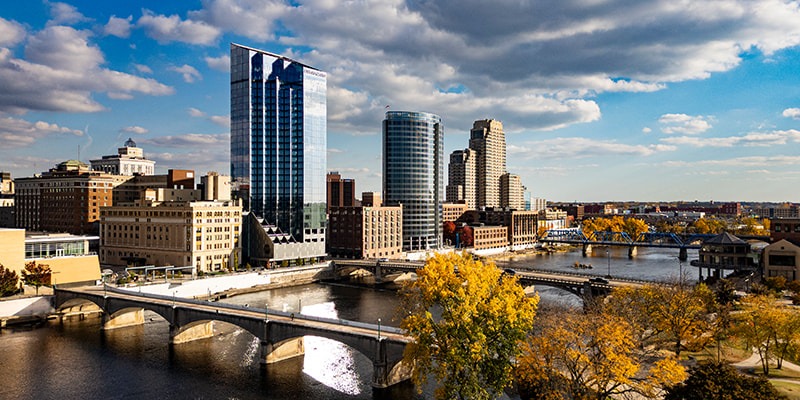
For years, the river was treated primarily as an engineering and flood-control challenge. Today, the city’s approach is different: the river is being reactivated as a public asset, a recreational corridor, and a platform for redevelopment. This includes major in-channel work—estimated at more than $20 million—that will remove dams in a safe and environmentally responsible way while improving usability for recreation such as boating and paddleboarding.
At the same time, trail connectivity along the river is becoming a defining feature. The city is part of a broader vision that links a roughly 70-mile corridor from Lowell to the Lake Michigan shoreline, with downtown Grand Rapids positioned as a central hub. The goal is a riverfront environment that is not only attractive but accessible—physically through trails and programming, and socially through intentional inclusion in contracting and economic participation.
This broader river strategy is reinforced by two major destination projects now moving forward: a new amphitheater expected to seat approximately 12,000 people and a new MLS NEXT Pro soccer stadium. The soccer team— AC Grand Rapids—will play in a stadium seating roughly 8,000. The venue will be named the Amway Soccer Stadium and will sit prominently along the river downtown.
For city leadership, these projects are not only about entertainment. They are catalysts that anchor mixed-use development, housing density, tourism and business growth. Between the amphitheater and stadium projects alone, the city is tracking approximately $1.3 billion in investment through major transformational brownfield plans, with over 1,100 housing units expected to be delivered as part of the surrounding redevelopment.

Courtesy of Experience Grand Rapids
Economic Development Director Sarah Rainero notes that much of this riverfront land was formerly underutilized—parking lots and brownfield sites are now being converted into hotel, residential, office, and entertainment infrastructure. The redevelopment is changing the physical landscape and strengthening the city’s position as a regional destination.
The Medical Mile: A Second Growth Engine
While riverfront redevelopment is one headline, another is the continued evolution of the Medical Mile.
Grand Rapids has become a nationally recognized hub for healthcare and research, anchored by Corewell Health, the Van Andel Institute, Michigan State University’s medical school presence, pharmacy education through Ferris State and nursing education through Grand Valley State University. New investments continue to expand the district’s impact and reach.
Washington highlights that this healthcare concentration strengthens the city in two ways. First, it improves quality of life by delivering top-tier care close to home. Second, it attracts and retains talent—students, researchers, clinicians and innovators—who then contribute to the region’s economic and cultural growth.
One recent project includes 118 new housing units tied to Corewell Health, designed to support medical residents and workforce needs while adding density near the North Monroe corridor.
Brownfield Tools and Streamlined Development
Grand Rapids is using Michigan’s brownfield framework not just as a funding tool, but as a strategic mechanism to unlock dense, mixed-use development where traditional economics may not pencil out. The city has worked closely with state partners to structure incentive packages that support both public-facing assets and private investment that surrounds them.
Turkelson adds that zoning reform has played an equally important role. Grand Rapids has implemented some of the more progressive “missing middle” housing reforms seen nationally, allowing small-scale multi-unit housing types to be built in more neighborhoods. These changes were supported by community input through recent updates to the city’s community master plan.
The result is a development environment where projects can move faster, face fewer procedural barriers, and align with long-term goals around affordability, density and neighborhood vitality.
Housing: From Market-Rate Supply to Supportive Solutions
Like most growing cities, Grand Rapids continues to face a housing shortage. City leadership is working to expand supply across the affordability spectrum, from market-rate units to workforce housing to supportive housing for residents experiencing homelessness.
Washington notes that Grand Rapids has enough shelter capacity so that no one needs to be outside during the winter months, and the city’s focus has shifted toward stronger case management and transitional pathways. One recent initiative included a tiny home development supported through partnerships with nonprofits and community organizations, providing stable housing paired with support and employment pathways.
Beyond supportive housing, the city has permitted more than 1,000 housing units over the past year, with several thousand more in the pipeline. Projects like Factory Yards, which repurposed an old furniture manufacturing facility through rezoning and mixed-use redevelopment strategies, represent how the city is converting legacy industrial sites into new residential density.
The city has also launched a land bank strategy aimed at activating tax-foreclosed and underutilized single-family properties. This includes permit-ready plans and incentive resources targeted to neighborhood-based redevelopment, encouraging residents and small developers to reinvest in the communities they already call home.
Equitable Opportunity: Small Business Access and Contractor Growth
Grand Rapids is pairing physical redevelopment with economic inclusion strategies, ensuring that opportunity extends beyond major developers and large contractors.
Equal Business Opportunity Program and River Equity Manager Alvin (AJ) Hills IV, oversees the city’s Micro Local Business Enterprise program, a race- and gender-neutral initiative designed to support emerging subcontractors headquartered in Kent County. The program helps small contractors build the financial readiness needed to compete for larger projects—especially around bonding capacity, a common barrier to scaling.
Through a new bonding support program, the city provides help with CPA-level financial documentation and construction financial management practices so small firms can qualify for bonding requirements and pursue larger contracts. The program also includes bid discount incentives for general contractors who utilize certified micro local firms.

Courtesy of Experience Grand Rapids
This approach is already creating participation opportunities across major projects, though the city notes that federal funding rules sometimes require adjustments in how incentives are applied. Beyond construction, leadership also sees vendor opportunities tied to new venues—food vendors and small businesses that can participate in amphitheater and stadium operations, not just in building them.
Infrastructure and Access: Airport Capacity and Regional Connectivity
Accessibility is part of Grand Rapids’ growth strategy. Washington points to significant investment tied to the Gerald R. Ford International Airport, including new concourses and gate capacity supported by an airport authority structure that involves multiple regional stakeholders.
While the airport is primarily located in Cascade Township, the city remains connected to corridor growth planning and infrastructure strategies along key routes such as 28th Street.
In Washington’s view, regional mobility and ease of access are essential if Grand Rapids is going to maintain its momentum as a destination and a hub for business recruitment.
Priorities for 2026
Looking ahead, Washington identifies several priorities that will shape the city’s next phase. The first is implementation—turning master plans into action through zoning updates, mobility improvements, and smart growth strategies that prioritize safety, walkability and infrastructure resilience.
The second is financial sustainability. With uncertainty around federal and state funding, the city is focused on ensuring it can maintain service levels and infrastructure investment as growth accelerates.
Finally, Grand Rapids is preparing for another downtown-focused planning effort that builds on the recently updated comprehensive master plan while refining the vision for the city’s core. The underlying principle remains clear: Grand Rapids is committed to continuous improvement, never assuming the work is finished and never standing still.
The city shows what can happen when development is guided by discipline. Through riverfront transformation, expanded housing, inclusive economic opportunity, and long-range planning, Grand Rapids is not simply growing—it is directing that growth with purpose.
Click The Cover To View Or Download The Brochure
AT A GLANCE
Who: Grand Rapids, MI
What: The county seat and a business hotbed primed for further development, focusing on housing, along with critical infrastructure to make it happen
Where: Kent County
Website: www.grandrapidsmi.gov