The ‘Energy’ City
Downtown Revitalization, Major Energy Investments, Housing Expansion, and Infrastructure Planning Form the Next Chapter
Known as Saskatchewan’s “Energy City,” Estevan has long played a central role in powering the province and supporting the broader regional economy. Today, that identity is not only intact—it is evolving.
As new energy opportunities emerge alongside renewed downtown momentum, infrastructure investment, and housing demand, Estevan is positioning itself for a future that blends its industrial strength with a growing focus on livability, innovation, and community experience. From nuclear and solar development to downtown revitalization, tech-sector diversification, and family-oriented planning, the city is moving forward on multiple fronts.
For city leadership, the message is clear: Estevan is building on its legacy while preparing for what comes next.
An Energy City with a Renewed Outlook
Located in southeast Saskatchewan, Estevan has long served as one of the region’s major economic hubs alongside Weyburn. For Mayor Tony Sernick, the city’s identity remains firmly rooted in the industries that have helped define it for generations.
“Estevan is known as the Energy City,” he says. “That quite explains what happens here.”
Surrounded by oil and gas activity, power generation, agriculture, and emerging critical mineral opportunities, Estevan remains a place where resource-based development shapes both local identity and long-term economic strategy.
While the city remains proud of that foundation, its outlook has shifted noticeably in recent years.
“In 2020, things weren’t looking too well for our city,” Sernick notes. “And in 2025, everything’s kind of done a 180.”
That reversal is being driven by a wave of major projects and renewed confidence in the city’s future.
Energy Investment Is Driving a New Era
Much of Estevan’s current momentum is tied to developments in the energy sector.
Among the most significant is the selection of Estevan as the site of Saskatchewan’s first small modular reactor project, a major step in the province’s nuclear energy future. At the same time, existing coal generation facilities are being extended and refurbished to help ensure continued power reliability for Saskatchewan.
The city is also poised to become home to the largest solar facility in Saskatchewan through the Turning Sun Solar project, formerly known as Iyuhána. That development adds another layer to Estevan’s already diverse energy profile and signals the city’s ability to remain relevant across multiple power-generation forms.
Together, these projects underscore Estevan’s ongoing importance in provincial energy strategy while reinforcing its role as a center for both traditional and emerging energy development.
The benefits are not purely industrial. They also create a ripple effect across housing, infrastructure, services, and local business activity—making it essential for the city to prepare thoughtfully for growth.
Downtown Revitalization Begins to Pay Off
While energy remains central to Estevan’s economy, the city is also investing in the heart of the community.
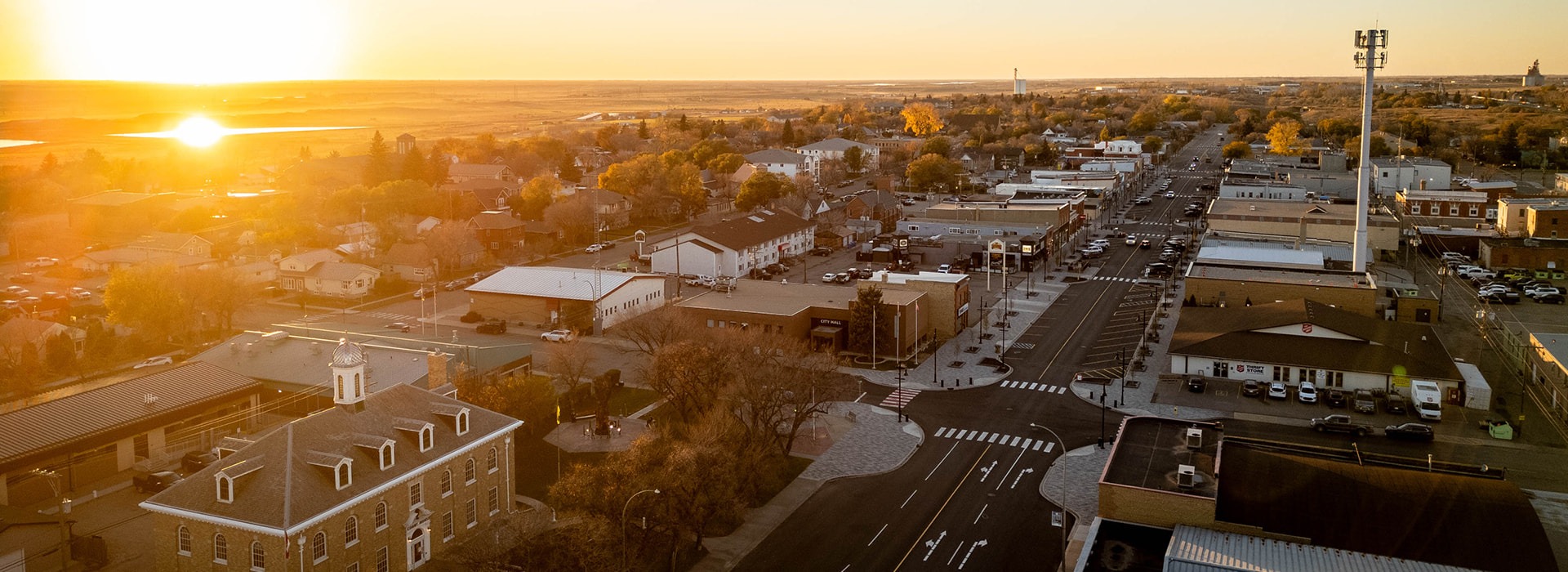
A major downtown revitalization project has now been completed, and city officials say the results are already visible. According to City Manager Jeff Ward, the improvements have helped create a more inviting, pedestrian-friendly environment that is beginning to attract new activity.
“We’re really seeing the benefits of that,” Ward says. “Vacant stores are being filled, and there’s more pedestrian traffic in that area.”
The revitalization has improved the look and feel of downtown while laying the groundwork for future programming and amenities. Benches, garbage cans, signage, and decorative lighting have either been added or are planned, helping create a stronger sense of place.
The city also worked closely with its downtown business association to brighten the district during the holiday season, further reinforcing the area’s appeal and encouraging residents to return to the core.
New Businesses and Business Incentives Support the Core
Downtown revitalization is also being matched by new business activity.
Recent additions have included a local coffee shop, a boutique liquor store, and several professional and service-oriented tenants such as realtors. Other vacant properties are now drawing interest as well, signaling the potential for continued occupancy gains.
To support both new and existing businesses, Estevan has maintained a strong incentive structure. According to Community Development Officer Rebecca Foord, the city offers tax incentives for new construction projects in the community as well as incentives for storefront upgrades and façade improvements.

Those programs have had a visible impact over the last several years.
“A lot of our downtown businesses have taken advantage of that,” Foord says. “Our downtown is really starting to look like a Hallmark movie.”
The city is also reviewing retention and expansion incentives for established and legacy businesses, recognizing that downtown vitality depends not only on new arrivals, but also on supporting long-standing operators that continue to anchor the community.
Creating a More Active Downtown Experience
Estevan’s vision for downtown goes beyond bricks and mortar. The city is also planning for downtown to become a more active event and gathering space.
As part of its emerging three-year strategic plan, council has identified multicultural programming and more activity downtown as important priorities. Infrastructure has already been built into the revitalized district to support that vision, including wiring for food trucks, temporary stages, and event use.
That opens the door for concerts, markets, and special events in the downtown core. Existing programs such as the downtown market, holiday shopping nights, and Christmas programming already provide a foundation to build on.
City leaders are now looking at how road closures, seasonal events, and multicultural gatherings could make even better use of the new downtown environment.
The goal is not simply to improve aesthetics, but to create an area that feels vibrant, welcoming, and alive throughout the year.
Infrastructure: The Foundation for What Comes Next
As exciting as new energy announcements and downtown improvements may be, city leadership is quick to point out that infrastructure remains the most important priority beneath it all.
“It’s boring to talk about,” Sernick says, referring to water, sewer, sidewalks, and related systems. “But it’s probably the most important piece of anything.”
In practical terms, that means Estevan is now focused heavily on the foundational projects needed to support future development.
One of the most important is a major $12 million water and sewer project that will serve a developing area of the city. While the project may not generate public attention in the same way as a high-profile new industry, its impact will be substantial.
The upgraded line will help service a planned 150-bed nursing home, support residential growth capable of housing thousands of future residents, and extend infrastructure closer to the city’s bypass corridor—an area that could eventually accommodate truck stops, commercial development, and related services.
That single project demonstrates how critical infrastructure can quietly shape an entire growth strategy.
For Estevan, the next few years will be heavily defined by this kind of work: the systems that make all other growth possible.
Housing Remains a Top Concern
Like many communities across Canada, Estevan is feeling the pressure of a limited housing supply.
The city is actively discussing new housing development with local builders and developers, particularly in areas that will become serviceable once water and sewer infrastructure is extended.
With energy-sector activity increasing and population growth anticipated, the need for both owner-occupied housing and long-term rentals is becoming more urgent.
The city is also paying close attention to senior housing needs. While the planned nursing home is an important milestone, officials recognize that there is also demand for housing options that serve older residents who are no longer suited to a traditional family home but are not yet ready for full care.
That middle ground—accessible, appropriately scaled housing for aging residents—has become an increasingly important part of the conversation.
At the same time, Estevan’s core already offers a relatively healthy mix of downtown and central-area housing, including apartments above businesses and some senior-oriented living spaces that allow residents to remain close to services and amenities.
That central housing pattern supports walkability and helps prevent the isolation that can sometimes come with aging outside of the urban core.
A Rural Tech Hub Adds a New Dimension
While Estevan’s energy economy continues to dominate the local story, the city is also working to diversify—and one of the most intriguing examples is its growing Southeast Tech Hub.
Foord describes the initiative as the first rural tech hub of its kind in Canada, aimed at showing entrepreneurs and technology-focused companies that they do not need to be based in a major urban center to succeed.
The premise is compelling: smaller communities like Estevan can offer lower costs, stronger personal connections, and an appealing quality of life while still supporting innovation-driven businesses.
The hub is now helping market Estevan as a place where tech entrepreneurs can live, work, and grow without the expense and anonymity of a large city. That shift opens the door to new forms of economic activity, from digital services and data-related operations to broader innovation-sector projects that complement the city’s existing strengths.
For Estevan, it represents an important form of diversification—one that broadens the city’s economic narrative without competing with its established energy identity.
Community Amenities and Quality of Life Matter More Than Ever
As Estevan grows, city leaders know that success depends not only on industrial investment but also on creating a community where people want to live.
That means parks, pathways, events, and everyday amenities remain an important part of the city’s strategy.
In recent years, Estevan has developed a 14-kilometre pathway system, improving connectivity and recreational access across the community. Indoor walking groups continue to use facilities like the local mall and rink throughout the winter, offering gathering opportunities even during the colder months.
The city is also seeing private investment in retail and commercial properties, including upgrades at the local mall, helping maintain activity in key commercial areas.
At the civic level, multicultural events and broader community programming are becoming a stronger focus, especially as the region’s demographic profile continues to diversify. Leadership wants to ensure that all residents feel included and connected to the life of the city.
This emphasis on livability also extends to family needs.
One of the most pressing concerns raised by local officials is the shortage of daycare spaces, with waiting lists estimated in the hundreds. Alongside housing and infrastructure, daycare has become a major quality-of-life and workforce issue. As Estevan works to attract and retain families, creating more childcare capacity will be essential.
The city is also focusing on park rehabilitation, ensuring that neighborhoods remain attractive and functional for young families and long-time residents alike.
Looking Ahead: Infrastructure First, Community Always
As Estevan looks toward the next several years, the city’s priorities are becoming increasingly defined.
Infrastructure will remain front and center, especially where it supports housing, institutional development, and commercial growth. At the same time, city leaders are also looking toward longer-term goals that could further strengthen the quality of life that would give residents more year-round recreational options.
Those may not be immediate-term projects, but they reflect the city’s willingness to think ahead.
Just as important is the collaborative approach underpinning Estevan’s progress. Sernick says his administration has placed a strong emphasis on relationships with provincial partners, local organizations, neighboring municipalities, First Nations, the chamber, economic development leaders, the Southeast Tech Hub, and Southeast College.
That network of cooperation is helping ensure that growth is not happening in isolation, but through shared goals and ongoing dialogue.
An Energy City Expanding Its Definition of Success
Estevan is still very much the Energy City. But its current story is larger than energy alone.
This is a community revitalizing its downtown, planning critical infrastructure, preparing for housing growth, exploring innovation, supporting new business, and investing in the everyday amenities that make a city livable. It is a place that understands that economic strength must be matched by community strength.
In that sense, Estevan is not just powering Saskatchewan. It is building a broader and more resilient version of itself.
For a city with such deep industrial roots, that may be one of its most important developments yet.
AT A GLANCE
Who: Estevan, Saskatchewan
What: The ‘energy’ city that is so much more and geared for its residents as it grows
Where: Saskatchewan, Canada
Website: www.estevan.ca
PREFERRED VENDORS/PARTNERS

ASL PAVING LTD.: www.aslpaving.ca
ASL PAVING Ltd, founded in 1950, serves Saskatchewan’s roadway construction market with offices in Saskatoon, Regina and Lloydminster. Built on strong customer relationships, quality workmanship and integrity, the company continues to embrace innovative equipment and industry best practices to deliver reliable infrastructure solutions for many rural and urban municipalities as well as private owners across the province.