A Sunny Economic Path Ahead
Building Arizona’s Competitive Edge Through Collaboration, Advocacy, and Education
In Arizona, economic development is not defined by a single city, a single sector, or even a single strategy. It is a statewide effort shaped by collaboration, sharpened by advocacy, and sustained by a growing network of professionals working across public and private sectors. At the center of that effort is the Arizona Association for Economic Development, a membership-based organization that has spent more than five decades supporting the people and partnerships that help Arizona grow.
Founded in 1974, the Arizona Association for Economic Development, or AAED, has evolved alongside the state itself. Originally focused on industry, the organization broadened its scope as Arizona’s economy became more diverse and interconnected. Today, with more than 450 members representing communities from Page to Douglas and every corner in between, AAED serves as a statewide professional association dedicated to strengthening the practice of economic development.
“Our focus is on the profession and the professionals,” explains CEO Katie Hurst. “We are strictly a membership association. We are not directly bringing projects into the area or doing tourism or business attraction ourselves. Our role is to support the people doing that work and to advocate for economic development as a profession.”
That distinction is important. While organizations such as the Arizona Commerce Authority and regional economic development groups lead specific attraction and expansion efforts, AAED provides the connective framework that helps those efforts succeed. Its mission rests on three pillars: educate, advocate, and collaborate.
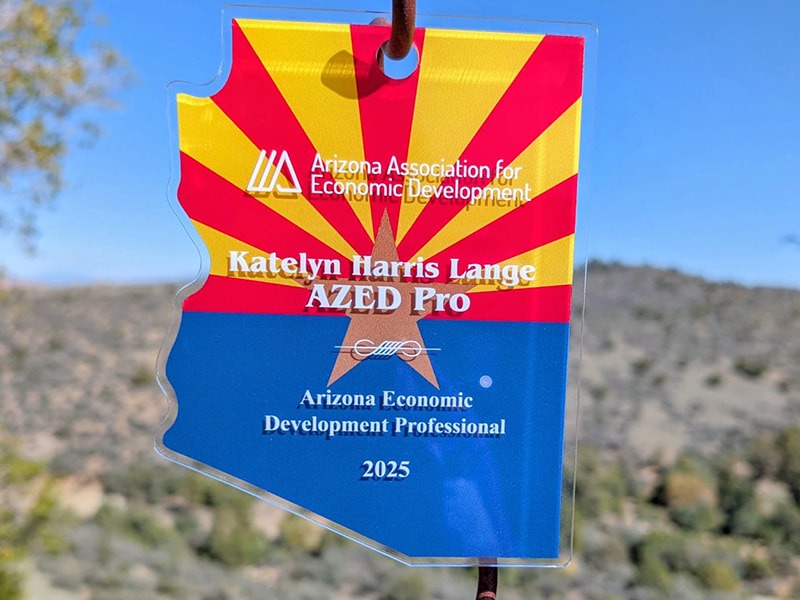
Education is one of AAED’s most visible contributions. Through its AAED Academy, the association offers a professional certification program for economic development practitioners called the AZED Pro. The academy requires participants to complete seven courses covering topics such as economic development drivers, finance and taxation, marketing and attraction, business retention and expansion, entrepreneurship, and small business development. What makes the program especially valuable is its Arizona-specific lens.
“Arizona doesn’t have the full slate of incentives that other states do,” Hurst says. “There are things unique to Arizona that our members need to understand. We use Arizona case studies and Arizona examples so the training is directly relevant.”
That tailored approach reflects one of the state’s defining strengths: Arizona is competitive precisely because it understands its own identity. It is a young state with expanding infrastructure, a business-friendly climate, and a growing population that continues to attract both employers and workforce talent from other parts of the country. It also offers advantages that are increasingly important in site selection conversations, including climate reliability, relative affordability, and a proactive approach to long-term planning.
For incoming AAED President Heath Vescovi-Chiordi, who also serves as Economic Development Director for Pima County, Arizona’s appeal comes down to a combination of natural advantages and strategic foresight.
“You’re looking at a unique area,” he says. “We’re the Desert Southwest. This is a very unique climate. No natural disasters, a reliable environment, and a lot of opportunity. But we also contend with natural resources in a different way than other regions, and that has led Arizona to develop some very intelligent, very sustainable systems.”
That long-term view is especially evident in the state’s infrastructure planning. Water, wastewater, electric grid reliability, fiber connectivity, and transportation all play a direct role in Arizona’s ability to compete for projects on a national and global scale. In southern Arizona, for example, Pima County is a regional wastewater provider, making infrastructure investment central to both community growth and economic expansion.
Transportation is equally critical. Vescovi-Chiordi points to the recent passage of the RTA Next program in southern Arizona, which will direct $2 billion over the next 20 years toward regional mobility improvements. Investments in Interstate 10 and other key transportation corridors are helping strengthen the connective tissue between Phoenix and southern Arizona, while grant mechanisms focused on water infrastructure are supporting efforts to address emerging needs such as PFAS remediation.
At the legislative level, AAED helps its members stay informed and engaged on the policy issues that affect their work. As a 501(c)(6) organization, the association devotes part of its budget to advocacy, particularly at the state level, while remaining focused on practical, nonpartisan outcomes.
“We’re really just looking broadly to ensure that Arizona remains competitive from an investment standpoint and supportive of business and community,” says Jennifer Lindley, Downtown Development Manager for the Town of Queen Creek and current AAED President. “Whether it’s workforce development, infrastructure investment, or site readiness, those are the things that directly impact us at the local level.”
That support matters because economic development today extends far beyond industrial recruitment. It includes housing, childcare, transportation, utility capacity, educational attainment, and quality of life. In Arizona, it also increasingly includes energy innovation. With roughly 350 days of sunshine a year, the state has natural advantages in solar generation, and that strength is being amplified by growing investment in battery manufacturing and energy storage.
“There are a lot of opportunities, and we get creative,” Vescovi-Chiordi says. “Solar generation combined with battery energy storage systems positions Arizona as a pioneer in clean and renewable energy. Then you combine that with things like microgrids, covered parking with solar, and incentive structures that support those technologies, and that becomes a real advantage.”
That innovation is showing up in major projects across the state. In Queen Creek, Lindley notes the significant impact of LG Energy Solution’s investment, which has brought ripple effects throughout the supply chain. In southern Arizona, Vescovi-Chiordi highlights the upcoming American Battery Factory project, a $1.2 billion investment expected to create 1,000 jobs over a decade, as well as a major data center initiative representing an estimated $3.5 billion investment over 15 years.
But while those headline-making developments are important, AAED’s leaders are equally focused on the strength of Arizona’s smaller communities and entrepreneurial ecosystems. One standout example is the Town of Superior, a community that has worked hard to redefine itself after the decline of its mining past.
“They decided they weren’t going to be defined by one thing,” Hurst says. “They’ve invested in tourism through Boyce Thompson Arboretum, repurposed their old high school into the Superior Enterprise Center to support welding and workforce training, and launched The Hive to improve digital literacy for children, older residents, and entrepreneurs. It’s an incredible example of a community building its future from the inside out.”
That broader view also shapes AAED’s work in workforce development. Arizona, like much of North America, faces persistent labor shortages across skilled trades, manufacturing, logistics, and other key sectors. But AAED sees workforce not as a standalone issue, but as part of a larger ecosystem.
“The workforce conversation is bigger than just the people,” Hurst says. “If you want to tackle workforce, you also have to address childcare, affordable housing, and transportation.”
The association’s Workforce Committee reflects that philosophy, bringing together professionals from workforce development agencies, childcare organizations, apprenticeship programs, and educational institutions. Across the state, community colleges are aligning curriculum so that training in one region translates to opportunity in another. There is also growing emphasis on dual enrollment, apprenticeships, and more affordable pathways to four-year degrees, all designed to help students enter the workforce faster and more effectively.
Looking ahead, AAED is continuing to invest in its own capacity as a statewide leader. In addition to its in-person academy, the association plans to launch a virtual version of its educational programming, expanding access and flexibility for members throughout Arizona. It is also developing advanced leadership training for seasoned professionals, aimed at those who have already spent a decade or more in the field and now need deeper, more specialized peer engagement.
The association’s two signature annual gatherings, the Spring Conference and Fall Forum, remain central to its mission, offering members opportunities to learn, connect, and share best practices. Those events, along with regional summits and recognition programs, reinforce the collaborative culture that AAED has built over time.
In a state defined by momentum, AAED plays a vital but often behind-the-scenes role. It is the convener, the educator, the advocate, and the support system for the professionals shaping Arizona’s economic future. And as the state continues to attract new industries, new residents, and new investment, that role will only become more important.
Arizona’s economic story is still being written. Thanks to organizations like the Arizona Association for Economic Development, it is being written with intention.
AT A GLANCE
Who: Arizona Association for Economic Development
What: The organization that helps to support business growth and communities throughout the state, through collaboration, education, and advocacy
Where: Phoenix, Arizona
Website: www.aaed.com