
Leveraging Location
How Access Fuels Long-Term Growth
DeForest, Wisconsin, has a long history of benefiting from connection. Located in Dane County, just north of Madison, the village has grown from an advantage that continues to shape its identity: access to major transportation routes that support both daily life and economic activity.
“At the heart of the village, the village was kind of grown on being on the main lines of transportation,” says Bill Chang, Village Administrator. “At first, the railroad, then the interstate. We have a U.S. highway that comes through town here, a couple of county highways, and a Wisconsin state trunk that comes through the village.”
That access helps explain how DeForest has evolved into a community that is both highly livable and increasingly business-focused. Chang describes a village that transitions from a traditional commuter suburb to a more self-sustaining community, with local jobs, expanded amenities, and a growing tax base.
“We started, I believe, as a bedroom community to Madison, being fortunate in the Dane County area, we’ve prospered as Madison has prospered and grown,” Chang explains. “Within the last decade or so, we’ve kind of transpired to intentionally becoming more than a bedroom community.”
Environmental Leadership Supports Economic Opportunity
Quality of life remains a major driver behind DeForest’s appeal, not only for residents but also for businesses evaluating long-term investment.
“As far as the residential side, I think it’s a great place to live,” Chang says. “We have a great school district. We have great recreation programming and special events in the village here, our park amenities, and I believe we have over 24 miles of recreation trail and paths.”
Natural resources also play an important role. DeForest sits along the Yahara River system, which feeds into the Madison Chain of Lakes.
“Recently, our stream was upgraded to a Class 2 trout stream, and we’re aiming to get to a Class 1 trout stream,” Chang notes. “That means quality habitat for trout to be able to produce here, and it shows how much we care about our natural environment while still maintaining good growth opportunities.”
For village leadership, environmental stewardship and economic growth move hand in hand rather than in opposition.

Building Connectivity in a Dispersed Community
DeForest does not follow the traditional model of a single downtown main street. Instead, the village is geographically dispersed, with multiple activity centers.
“If you look at a map of DeForest, we’re very dispersed in that we don’t necessarily have a main street downtown, typical of some other communities,” Chang explains.
That layout creates planning challenges, particularly around connectivity. Residential neighborhoods, retail areas, and public gathering spaces are distributed across the village, necessitating thoughtful redevelopment strategies.
“There’s not that connectivity, and we understand that, and we are addressing that through our redevelopment plan,” Chang says.
The village’s approach focuses on strengthening the core, improving connections between activity zones, and enhancing cohesion as DeForest continues to grow on both its north and south sides.
Leveraging Transportation Corridors
The interstate and Highway 51 corridor serves as DeForest’s strongest economic driver. Chang says the village has experienced significant growth along these transportation routes, attracting businesses that value access and logistics efficiency.
“We’ve seen a lot of growth, especially along the interstate corridor and the U.S. Highway 51,” Chang says.
While warehousing and distribution are a natural fit, DeForest works to attract higher-value development that brings long-term stability.
“We do see a lot of transportation, warehousing, distribution-type services,” Chang says. “But we’ve been very successful in saying, hey, that’s great. We’d love to see you bring in more parts of your business, whether it’s the office side or the HQ side.”
That strategy strengthens the local employment base while supporting fiscal sustainability.
Preparing the Village for Large-Scale Investment
One of the most significant recent projects to have proposed a development in DeForest is the QTS data center investment. While the project was ultimately not approved, Chang explains that DeForest’s infrastructure readiness is a key factor in attracting this type of development.
“They’re interested in the village primarily because of the connection to not only the public infrastructure on highways and roads, but really the other utilities,” Chang explains. “Specifically, the electric utility, which has a substation where it was proposed.”
Chang clarifies that the QTS site was outside village boundaries but QTS pursued annexation.
“It’s currently not in the village of DeForest. It’s looking to annex into the village,” Chang says.
Clear land-use processes play an important role in advancing projects like QTS. “We were very direct in defining our process and having that process be effective and efficient,” Chang adds.
A Growing Business Ecosystem
QTS’s interest in the community is one of several major investments that reflect DeForest’s strong business climate. Chang points to a range of employers that have recently expanded or relocated to the village.
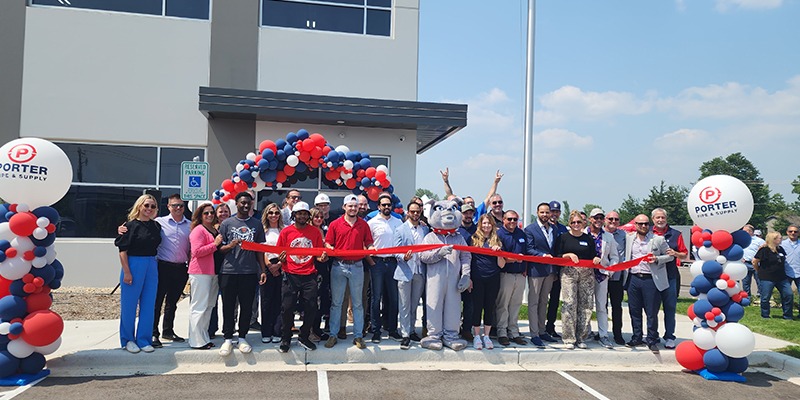
“I think that’s also led to getting other organizations here like Kwik Trip, Lake City Glass, Hooper Corporation, Bell Labs, and some of the other businesses that have come to the village recently,” Chang says.
Headquarters relocations are particularly meaningful. “Lake City Glass has recently come, and they brought their headquarters here,” Chang adds. Local success stories remain just as important. “We already have other strong businesses in town,” Chang says. “EVCO Plastics is a large, homegrown business that started here and has prospered in our community.”
Balancing Residential and Business Growth
Maintaining balance remains a central theme in DeForest’s planning philosophy.
“We want to be able to balance our business growth with our residential growth,” Chang says. “Residential services are financially heavy on parks, recreation, fire, EMS, and police, and business growth helps offset those costs.”
That balance is reflected in the village’s current makeup. “Village-wide, we’re roughly 70 percent residential and about 30 percent business,” Chang explains. DeForest’s geographic position allows residents and workers flexibility while strengthening the local economy.
“We’re geographically very well situated, being kind of the northern suburb of Madison,” Chang says. “You can live here and work elsewhere, or live elsewhere and work here.”
Smaller Developments, Broader Housing Options
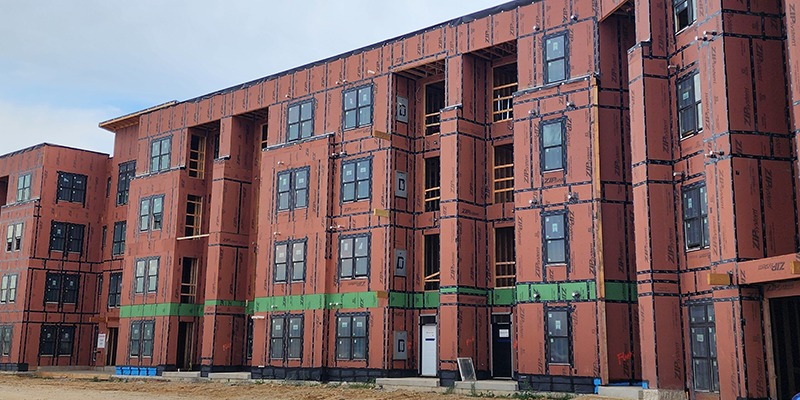
Housing development in DeForest continues to evolve. Larger subdivisions dominated earlier growth cycles, while newer proposals tend to be smaller and more diverse.
“Before the pandemic, we saw a lot of single-family residential housing developments of a larger subdivision nature,” Chang says. “More recently, subdivision sizes are smaller.”
The village encourages mixed-housing developments that include single-family, mid-density, and high-density units. “We continue to try to maintain that mix,” Chang explains.
While rising construction costs and limited supply affect the entire region, Chang believes DeForest’s diversity has helped it remain resilient.
“We’ve been able to maintain our growth through those challenging times because the sectors and diversity in the village shift,” Chang says.
Aligning Infrastructure Strategy with Community Needs
To support development, DeForest relies on tax increment financing districts to fund infrastructure expansion. “We utilize our tax increment districts to bring in business development, and that allows us to expand critical infrastructure,” Chang says.
Strategic sequencing helps reduce costs and improve efficiency. “If we can connect gaps between the core and the highway with water, sewer, and roads, those other utilities usually follow,” Chang explains. Community connectivity remains a priority through trails and neighborhood planning.
“We ensure community connectedness by always looking for opportunities for trails and connections,” Chang says.
Events and Programming
Public spaces and events help unify a geographically dispersed community. Chang highlights communications and programming as essential, then turns to the village’s communications leadership.
“Fireman’s Park has really become the hub of our community,” says Stacey, Communications Manager. “We host a regional art fair that kicks off summer, followed by concerts, movies, and night markets.”
Trail-based events bring residents into different neighborhoods. “Yahara River Fest allows people to walk the Upper Yahara trail system and see the Yahara River up close,” Stacey says. Winter events continue that focus with the Candlelight Hike, which introduces residents to a park they might not even know is there—nestled in the heart of our community, a true hidden gem. We’re so proud of our trail and park system and love sharing it with everyone,” she adds.
Thinking Generations Ahead
Looking ahead, Chang says sustainability and long-term planning will guide the village’s priorities.
“Understanding our growth rate and continuing to balance that growth is first and foremost,” Chang says. “Sustainability matters financially and long-term.”
With limited growth remaining inside current boundaries, DeForest is planning. “Within our municipal boundaries, we have about five to ten years of growth left at the rate we’re going,” Chang explains. “So, the question becomes, what is next?”
Future planning includes water infrastructure, west side expansion, and long-range visioning. “We’re looking at what the next 30 to 50 years of the village looks like and starting to plan that now,” Chang concludes.
A Thoughtful Path Forward
DeForest continues to move forward with a clear understanding of its strengths and responsibilities. By pairing infrastructure readiness with balanced growth and long-range planning, the village is laying the groundwork for a stable, connected future that benefits residents, employers, and the broader region.
Click The Cover To View Or Download The Brochure
AT A GLANCE
Who: DeForest, WI
What: A fast-growing Wisconsin village that leverages its transportation access, balanced planning, and community investment to support long-term economic and residential growth.
Where: Dane County, Wisconsin, located North of Madison.
Website: www.deforestwi.gov
PREFERRED VENDORS/PARTNERS

Hooper Corporation: www.hoopercorp.com
Hooper is a well-respected electric power and mechanical contractor, delivering expert fabrication and installation of complex plumbing, process piping, fire protection, and HVAC systems, as well as substations and high voltage transmission lines. Hooper’s Service Division also provides reliable heating, cooling, plumbing, and fire protection services for homes and businesses.


Vierbicher: www.vierbicher.com
Vierbicher is a Wisconsin-based firm specializing in community planning, civil engineering, and development services since 1976. With offices in Reedsburg, Madison, Prairie du Chien, Milwaukee, and Green Bay, they serve municipal and private clients, offering expertise in land surveying, GIS, and Tax Increment Financing (TIF) to create sustainable, actionable projects.