
Embracing Learning and Its Students
A Liberal Arts Foundation with a Community Heart and a Career-Ready Focus
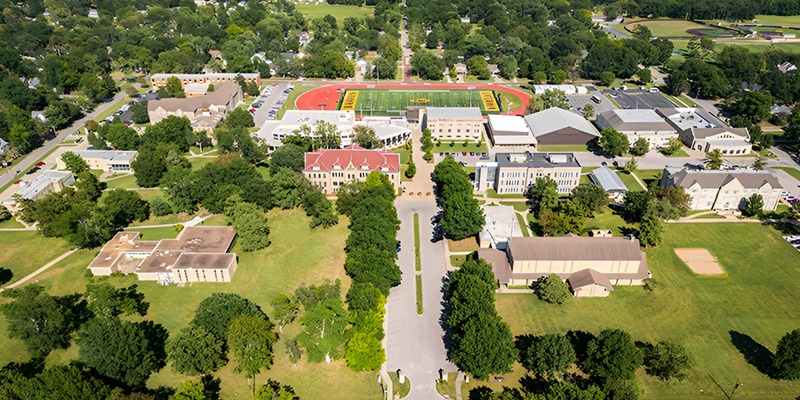
In Ottawa, Kansas, Ottawa University’s campus operates with a sense of purpose that is both historic and forward-looking. As Campus President Dr. Bambi Burgard explains, the institution’s roots date back to 1865, when it was founded through an agreement between American Baptist missionaries and the Ottawa tribe. That original commitment remains active today: tribal students attend the university at no cost, and the campus continues to carry a strong Christian identity grounded in service, stewardship, and personal development.
Ottawa University is part of a broader system, with additional campuses and learning platforms that extend its reach. But on the Ottawa, Kansas campus itself—home to just under 1,000 students, including roughly 875 undergraduates—the mission stays clear: prepare graduates through a liberal arts education for meaningful careers and a life of service to others.
For Burgard, the strength of the liberal arts model is not nostalgia. It is a necessity.
Critical thinking, strong writing, collaborative problem-solving, and the ability to lead in diverse environments are the competencies that remain durable no matter how the economy shifts. Ottawa’s approach is to develop well-rounded graduates who can think, communicate, and adapt—then connect that foundation to practical professional pathways.
Community Engagement That Starts Early
Ottawa University’s presence in the region extends beyond college recruitment. The campus engages students in the community at multiple levels—elementary, middle, and high school—through programs that build relationships and create visibility in meaningful ways.
University students, including student-athletes, regularly participate in school-based engagement efforts such as “High Five Fridays,” mentorship-style initiatives, and a Lunch Buddies program that pairs university students with middle and high school students, particularly those considered at-risk. The intent is twofold: encourage young students to imagine college as attainable and provide support systems that reinforce stability, motivation, and direction.
The campus also hosts a children’s literacy conference each summer, bringing local students onto campus to work with authors and engage with reading and storytelling in a structured, inspiring environment. It is one of several examples of how Ottawa University positions itself not only as a destination for higher education, but as a partner in youth development and community life.

Leadership Opportunities with Local Impact
Leadership at Ottawa University is not confined to student government titles or campus clubs. One initiative launched recently embeds students directly into community leadership structures.
The university has partnered with the Ottawa Area Chamber of Commerce to place students on the chamber’s committees and in its meetings—giving them exposure to civic planning, local business priorities, events, and legislative engagement.
Students participate in committees such as events and promotions, ambassadors, and legislative action. The goal, as Dean of Student Life and Services, Dr. Donald Anderson explains, is to build professional growth opportunities while ensuring students have a voice in the community they live in.
The university is also exploring similar participation with Ottawa Main Street, extending the same concept: help students build leadership capacity by engaging in real local decision-making environments—not simulations.
Scholarships and Alumni as “Pay It Forward” Leaders
Ottawa’s advancement work is deeply tied to scholarship opportunities. Derek Chappell, Leadership Gift Officer in the university’s advancement office, describes a fundraising culture built on a simple premise: alumni and supporters help provide the same opportunity they once received.
Scholarships are supported through endowment growth and targeted giving across programs, athletics, and academic disciplines. One notable example is the Franklin County High Achiever scholarship competition, designed to attract top students from area high schools with the opportunity for full tuition support.
Ottawa’s alumni network is not only a fundraising base—it is a living extension of the institution’s influence. As Jay Kahnt, Director of Administrative Operations and a longtime community member, notes, Ottawa University graduates are embedded throughout the county’s workforce.
Teachers, healthcare professionals, entrepreneurs, and business leaders across the region are OU alumni—many of whom came to Ottawa, built careers, and stayed. In that way, the university’s investment in students becomes an investment in the economic and civic stability of the entire community.
A Campus Defined by Student-Athletes and the Skills They Build
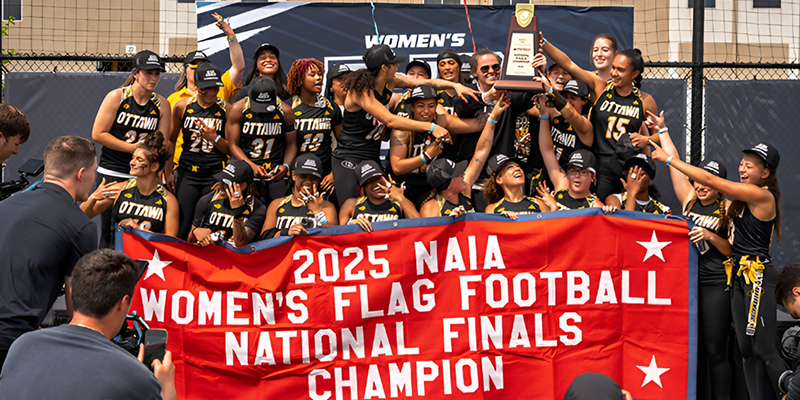
One of the most distinctive features of the Ottawa campus is its extraordinary concentration of student-athletes. Burgard notes that approximately 95% of Ottawa’s students participate in athletics—a figure far above that of typical peer institutions.
This athletic culture is not framed as extracurricular dominance; it is positioned as a developmental advantage. Team dynamics, discipline, time management, coachability, strategic thinking, resilience, and communication are all reinforced through sport—and then translated into leadership and workforce readiness.
Ottawa’s athletics program has expanded dramatically over the past two decades. Kahnt—who coached softball for 23 years and is recognized as the winningest coach in OU athletics history—describes growth from roughly 12–13 sports and 250 student-athletes in the early 2000s to more than 30 sports today and over 800 student-athletes. That expansion includes not only new sports, but larger rosters and developmental/JV opportunities, widening access and engagement.
Importantly, university leaders emphasize that athletics is part of a broader model: students are encouraged to translate athletic experience into leadership roles across campus life, student organizations, and professional development initiatives—because the goal is never simply participation. The goal is preparation.
Career Development and Healthcare Pathways
While rooted in liberal arts, Ottawa is not operating in isolation from workforce realities. The campus is actively strengthening career services and expanding structured career preparation.
Burgard describes the development of two new “bookend” courses to guide students through career exploration and career launch planning.
The long-term vision is for every student to become internship-ready, with a strong push for professional internships between junior and senior years. Ottawa’s leadership recognizes that experiential learning is one of the most decisive factors in post-graduation employability.
Healthcare is a major area of momentum. Ottawa recently hosted a panel discussion in collaboration with AdventHealth, bringing professionals—including a behavioral therapist, OT, PT, ER nurse, and physician assistant—onto campus to speak with students interested in healthcare careers. This engagement aligns with Ottawa University’s broader system-level expansion, including the launch of a physician assistant program on the Kansas City campus.
The University’s Ottawa campus students are supported through pre-PA and allied health pathways that connect undergraduate preparation to advanced degree opportunities.
For the university, healthcare initiatives are not a departure from liberal arts—they are an extension of it. The institution’s philosophy remains whole-person development, applied to high-demand professional fields.
Capital Investment and Preserving a Historic Campus
Ottawa’s campus includes significant historic infrastructure, and current capital planning reflects both preservation and modernization priorities. Burgard points to the Administration
Building—dating back to 1902—as a key focus of renewal. It houses major campus functions, including student life, business operations, classrooms, and student services, and remains heavily used by the entire student body.
The university has launched an Administration Building Renewal Project as part of broader campus master planning, with support from alumni initiatives such as the Class of 1975’s 50th homecoming fundraising efforts. While Ottawa’s broader campaign is more focused on people and programs than facilities, leadership sees strategic capital renewal as essential to student experience and long-term institutional health.
A Liberal Arts Model with Measurable Community Return
Ottawa University’s story is ultimately one of alignment: historic mission, modern workforce needs, and a deep, visible community presence.
The campus is committed to preparing graduates who can think critically, communicate effectively, lead collaboratively, and serve meaningfully—skills that remain indispensable no matter how careers evolve. At the same time, the institution is investing in career services, healthcare pathways, community-based leadership development, and scholarship growth to ensure students have both a strong foundation and a practical launchpad.
And in Ottawa, Kansas, the community impact is tangible. Alumni are not just former students—they are teachers, employers, business owners, and civic leaders shaping the region’s present and future. In that sense, Ottawa University does not simply educate students and send them away. It builds people who often stay, lead, and invest back into the place they now call home.
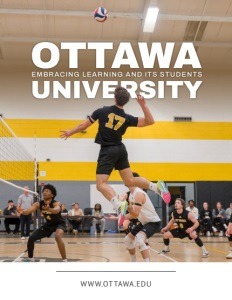
Click The Cover To View Or Download The Brochure
AT A GLANCE
Who: Ottawa University
What: A leading liberal arts-focused university that is committed to its students and the community
Where: Ottawa, Kansas, USA
Website: www.ottawa.edu
PREFERRED VENDORS/PARTNERS

Ottawa University: www.ottawa.edu
Building on its foundation as a Christ-inspired community of grace and open inquiry, Ottawa University prepares professional and liberal arts graduates for lifetimes of personal significance, vocational fulfillment, and service to God and humanity. Founded in 1865, the University serves students in Kansas, Arizona, Wisconsin, nationally, online and globally.